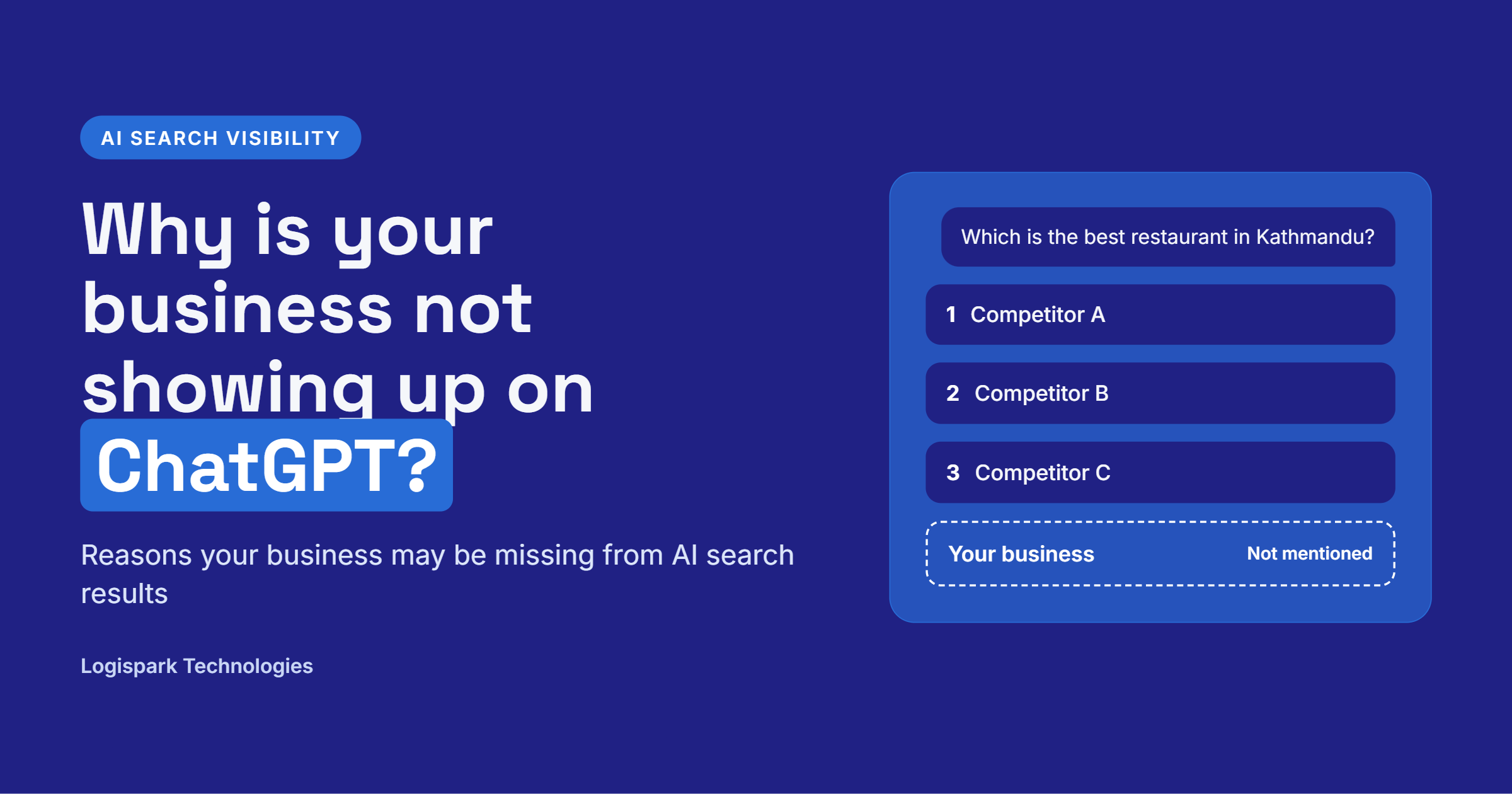
Why is your business not showing up on ChatGPT? Reasons Your Business May Be Missing from AI Search Results
Have you ever asked ChatGPT or any other AI about your own business? And it names your competitors but not you ?
Why does ChatGPT name your competitors but not you? It is rarely random. AI tools build answers from what they can find, read and trust, and if your business is hard to find, hard to read or rarely mentioned elsewhere, it gets left out.
Does this really affect customers? Yes, because AI answers now sit between people and your website. Pew Research Center tracked the browsing of 900 US adults and found that people clicked a traditional search result in 8% of visits when Google showed an AI summary, compared with 15% when it did not. Only 1% of visits included a click on a link inside the summary itself. Source
This guide covers six common reasons a business is missing from AI search results, with a fix for each. It draws on research reported by Search Engine Land and on studies from Ahrefs, Muck Rack, Seer Interactive, Pew Research Center, OpenAI and Google.
What does it mean to “show up” in ChatGPT?
AI visibility means your business gets mentioned or recommended when someone asks an AI tool a question related to your industry. For example, someone might ask, “Which restaurant POS software is IRD-certified in Nepal?” or “Who develops mobile apps in Kathmandu?”
ChatGPT can answer questions using information it has already learned or by searching the internet for updated information. According to a Semrush study reported by Search Engine Land, ChatGPT searched the web for 34.5% of user queries, compared to 46% in late 2024. Source
What does this mean for your business? You need to be visible in both places. Having your business mentioned on trusted websites helps AI tools recognize your brand, while having a well-structured and accessible website makes it easier for them to find and use your information when searching the web.
How can I check whether my business appears in AI Search Results?
You can run a basic visibility check in under an hour. Follow these steps:
List 10 to 20 questions your customers would ask, such as “best burger in Kathmandu”, “who offers restaurant management in Nepal” and “T’s Your Palate reviews”.
Ask each question in ChatGPT, Gemini, Perplexity, Claude and Google AI Mode, using fresh chats. Record whether your business is mentioned, how it is described and which websites are cited.
Search the same questions in Google, and note whether your pages appear.
Repeat every month, because AI answers can differ between sessions.
Does Logispark have a tool for this? Yes, we have our own tool that checks whether your business appears in AI search results. Book a consultation and we will run it for your business and walk you through the results.
If your business does not show up in the AI searches, ask yourself these 6 questions:
Is my website blocking AI crawlers?
Your website might be preventing AI search engines from accessing its content without you realizing it. AI platforms use automated crawlers to discover and collect website information. If your website blocks these crawlers, some AI platforms may not be able to access your pages or use their content in search results.
Check your website's robots.txt file to see whether relevant AI crawlers are blocked. Also, review your website's indexing settings, server access and page restrictions. Make sure important pages, such as your homepage, service pages and blogs, are accessible to the search engines you want to reach.
What to do: Open yourdomain.com/robots.txt, for example “logisparktech.com/robots.txt” and look for rules that block OAI-SearchBot, or a blanket “Disallow: /” under “User-agent: *”. Remember that different crawlers have different purposes, and allowing a crawler does not guarantee that your website will be cited.
Does my content answer the questions customers actually ask?
AI prompts are longer and more conversational than traditional searches. In the Semrush data reported by Search Engine Land, between 65% and 85% of ChatGPT prompts did not match standard keywords. Pew found that only 8% of one- or two-word Google searches produced an AI summary, compared with 53% of searches of ten words or more. Source
What should you do about it? Think about what potential customers ask before choosing a business. For example, someone looking for restaurant management software might ask, "What is the best POS software for restaurants in Nepal?" or "Which restaurant software supports inventory management?"
Your website should provide clear answers to these questions through service pages, blogs and FAQs. Instead of focusing only on promotional content, explain your services, address common problems and provide useful information that helps customers make decisions.
What to do: Research customer search queries and frequently asked questions. Create content that answers them directly, using clear headings and simple explanations.
Do trusted websites talk about my business?
Your website is not the only place AI search engines can find information about your business. They may also use information from news websites, industry publications, business directories, review platforms and other trusted online sources.
If your business has very few mentions outside its own website, AI platforms may have less information to understand your brand, verify what you offer and assess its relevance.
For example, if your company provides digital marketing services, mentions in relevant marketing publications, industry directories and credible business websites can help strengthen your online presence.
What to do: Build your brand presence beyond your website. Get featured in relevant publications, maintain business directory listings, encourage genuine customer reviews and develop relationships with credible websites in your industry.
Is my business information inconsistent across the web?
AI tools can only describe your business accurately if your sources agree with each other. If your name, services, location or prices differ between your website, LinkedIn, Facebook, directories and Google Business Profile, the information becomes unreliable.
What to do: Review your business information across your website, Google Business Profile, social media accounts and business directories. Keep your company details, contact information and service descriptions accurate and consistent everywhere.
Is my content too generic to be cited?
Publishing content regularly does not automatically make your website a useful source for AI-generated answers. If your blogs repeat the same general information available on hundreds of other websites, they may offer little reason to reference your business.
What makes content worth citing? Specific facts such as prices, timelines, local rules, named examples, original data from your own projects, and a named author with relevant experience. Replace vague claims like “we offer the best service” with details a reader could check.
AI platforms are more likely to find value in content that provides clear explanations, useful details, credible information and original insights.
What to do: Focus on creating original, informative and experience-based content. Support your claims with reliable sources, include relevant examples and provide information that readers cannot easily find everywhere else.
Does My Website Have the Right Technical Structure for AI Search?
No, not for Google’s AI features. Google published a guide on 15 May 2026, which Search Engine Land and Semrush reported, saying site owners do not need special AI markup, llms.txt files or content chunking to appear in AI Overviews and AI Mode. Source
Does this apply to ChatGPT or other AI Chatbots and other AI agents too? Not necessarily, because Google’s guide covers only its own products. Schema markup still helps search engines understand information on your website, such as your business details, services, articles and FAQs. While structured data can improve how your content is interpreted, it does not guarantee AI citations or recommendations.
What to do: Prioritize a technically accessible website, well-organized content, accurate business information and relevant structured data. You can consider implementing llms.txt as an additional resource, but don't treat it as a replacement for proper SEO, AEO or GEO optimization.
After reviewing these areas, you may have a clearer idea of why your business is missing from AI search results. Improving AI visibility is not about adding one technical file or publishing more blogs. It requires a combination of accessible website content, clear answers, credible brand mentions and a consistent online presence.
Not sure how visible your business is across AI search platforms? Get an AI visibility audit from Logispark Technologies and identify opportunities to improve your website's discoverability.
Frequently Asked Questions
How can I make my website visible on ChatGPT?
Start by ensuring your website is accessible to relevant crawlers. Publish helpful, well-structured content, answer common customer questions, maintain accurate business information and build your brand presence on credible websites.
Does Google ranking guarantee visibility on ChatGPT?
No. Ranking well on Google does not guarantee that ChatGPT will mention or recommend your business. AI platforms use different methods to discover, retrieve and select information.
How long does it take for a website to appear in AI search results?
There is no fixed timeline. It depends on factors such as website accessibility, content quality, brand authority and how frequently AI platforms update or retrieve information. Improvements may take time, and visibility can vary between platforms and search queries.
Can small businesses compete in AI search results?
Yes. Small businesses can improve their AI search visibility by publishing useful industry-specific content, maintaining accurate business information, building credible online mentions and clearly explaining their products and services.